Mostrando postagens com marcador interview. Mostrar todas as postagens

quinta-feira, 10 de maio de 2018

Artigo Especial com SiFu Lo Man Kam

The Dido's Blog returns with special article. This time, we reproduct a good interview with SiFu Lo Man Kan to New Hero magazine. We Hope that you enjoy it.


Special Interview with Wing Chun Grand Master Yip Man’s Nephew, Sifu Lo Man Kam in Taiwan

by New Hero Magazine
A Retired Army Major – The first person to bring Wing Chun Kung Fu to the Taiwan public


In 1950, Grand Master Yip Man began teaching Wing Chun at the Kowloon Mess Union. His early followers at that time included Leung Sheung, Lok Yiu, Cheu Sheung Tin, Jiu Wan, Yip Bo Ching, and others. However, not many know that Lo Man Kam, Yip Man’s nephew through his oldest sister, also began studying Wing Chun at that time, training with Leung Sheung and Lok Yiu on the rooftops of the Mess Union, along with another student, Yip Man’s good friend, Lee Ming. From the Mess Union, Grand Master Yip Man moved his school to Hia Ten Street, Lee Da Street, and later Lee Jenwou Village.  For nearly 10 years, wherever Yip Man moved, Lo would always follow.


Kung Fu brother reunion
First row – (L to R) Cheu Sheung Tin, Yip Chun, Lok Yiu, Lo Man Kam and Sam Lau.

Then in 1960, persuaded by his uncle, Sifu Lo moved to Taiwan to enroll in military school. Over 3 years special forces training, he learned many kill techniques, defense tactics, and other martial arts skills like Judo and Chin-Na Shou for close-quarters combat. After graduating from military school, he was assigned to serve at a special union and, due to the nature of his job, frequently had chances to utilize Wing Chun and other martial arts skills that could be combined together to form a very unique close range combat system. As a result, though Sifu Lo left Hong Kong, his Wing Chun never became rusty, much like the old Chinese saying “Kung-fu always stays with you.”  During his time in Taiwan, Sifu Lo also had a chance to meet his kung-fu brothers such as Lok Yiu, Jiu Wan, and Sam Lau.
After meeting with his cousin, Yip Chun in Taipei in 1974, he was encouraged to develop and spread Wing Chun in Taiwan.  Shortly after retiring from the Army as a Major in 1975, Sifu Lo opened his first school in Taipei. Before long, the Chinese kung-fu action star Bruce Lia also joined his school, training under him and even cooperating on a few kung-fu movies together. Since that time, Sifu Lo has always kept his school open to the public, making teaching his full-time job, career, and mission.  Almost every day and every night has been focused on developing and maintaining the high standard of Yip Man’s Wing Chun in Taiwan.

Sifu Lo’s Wing Chun school in Taipei, Taiwan

In October 1975, Sifu Lo accepted his first foreign student, Daniel Duby, a son of a chief of police from the French island of Réunion. Having a foreigner come to Taiwan study kung-fu was quite unusual, since Taiwanese society was very conservative. As such, the Taiwanese Foreign Affairs and Overseas Compatriot Affairs Commission helped and provided all necessary support to Sifu Lo and Daniel Duby.  Publicity about Sifu Lo’s kung-fu school spread and became hot news, as this was the first Taiwan school to open its doors to foreign students of Chinese Kung Fu. Taiwan would gradually become more accessible to the rest of the world, with many people coming to do business, study Chinese, or even teach English.  And because Sifu Lo had studied at the Hong Kong Wan Chai English College, teaching kung-fu to foreigner was never a problem for him.

Sifu Lo with his foreign and local students.

Word spread quickly of his enthusiastic teaching, with many foreigners desiring to study Chinese kung-fu coming just to him, until it made Sifu Lo’s school what might be described as a kind of kung-fu “United Nations”. Aside from Hong Kong and Macao, students have come from the US, Germany, France, England, Switzerland, Belgium, Norway, Sweden, Denmark, India, Saudi Arabia, and many more to study Wing Chun under Sifu Lo.  As a result of his “Kung-fu UN,” tournaments in Taiwan steadily became popular.  Whenever a foreign team has visited Taiwan, Sifu Lo has always been on the panel of ambassadors represents Taiwan.  Even early on, when former Hong Kong Chinese Martial Arts Association chairman So Yuen would bring tournament participants over, he would always pay a visit with Sifu Lo, while also getting together with other Sifus and mutual friends like Lo Kay and Xie Kwong Yin.

Some readers may remember an article from Yip Chun mentioning Sifu Lo’s having provided some help to Mr. Deng Sheng (a former Hong Kong Chinese Police Detective and the first chairman of the Wing Chun Athletic Association). When we asked sifu Lo about the matter, he would only say that it was just “a little favor” without any need to talk about it.  It turns out that small favor was providing help not just to Mr. Deng Shen, but also to all his police colleagues when they came to Taiwan, including Chan Kam Pui, Chan Jiang, Fai-Zhai B, and Chan Xin, with whom he has since become good friends.  When Mr. Deng Sheng was injured in a horse-riding incident, Lo provided physical therapy for him every day.  From what we’ve heard, Sifu Lo has always had a good relationship with people in Taiwan, ever happy to help without promise of return.   But though he is very proficient in Chinese medicine and physical therapy, he nevertheless chose not to focus on such skills for a career, opting instead to follow his passion and spread Wing Chun throughout Taiwan and the world, which he believes is the best way to thank his uncle, Yip Man, for the many years of teaching and encouragement, as well as his cousin Yip Chun for his support, which has led to Sifu Lo being the only Wing Chun master in Taiwan.
The long years of Taiwan Special Forces training have helped Lo fit the old Chinese proverb, “Once you move, I will move faster; and my power will be like the mountains coming to you.”  By applying his own theories to kung-fu, he has also been able to create a unique style, underlining Yip Man’s saying that, “Kung-fu has no life of its own, a person must bring it to life.”  Within this style is a key concept that one should always stick with and control an opponent at every chance, never letting go and always following-up, even if one needs to throw or apply joint-locks.  His moves, techniques, and training methods were loved enough by Europeans that, over time, they began to call it “Lo Man Kam Wing Chun”.   Sifu Lo says of his methods, “It is fighting with Wing Chun theories and not giving slack, once on the attack.”
Developing training with hand-to-knife combat


Sifu Lo has also taken aspects of other styles and combined them with Wing Chun “sticky hands” techniques, often favored by intelligence and law enforcement personnel for their effectiveness, and passed them to his son, Gorden, which led to his being selected to join the Army’s martial arts team and act as an assistant instructor. After a 1991 speech at the Taiwan National Police Agency First Headquarters on the topic of “How to promptly restrain a criminal with police defense tactics,” Sifu Lo was immediately invited by general commander Lu from the 1st Headquarters to be an instructor on defense tactics.  The special training courses he conducted during that time actually utilized real 45cm long machetes and US military combat knives, because he felt that “Frontline law enforcement needs to have very good skills and realistic experiences to react to; and this is the first time this kind of realistic training was given in Taiwan.”
Later, a major break-in in Kaohsiung showed the police to be under-prepared, and so Sifu Lo was assigned to make a proposal to create a national SWAT team.  He was put in charge of all police defense tactics, including hand-to-hand and hand-to-weapon combat.  The outstanding outcome of the training resulted in Lo’s being invited to teach at the Taiwan Investigation Bureau for 10 years.
In 1993, general commander Lu was promoted to preside over the Taiwan Police College, so again he invited Sifu Lo to teach at the Police College, as well.  By now, Lo’s son Gorden had finished his military service and, with his added Wing Chun skill, was also qualified to help his father there as an assistant instructor.  From the experiences gained there, Gorden improved his skills and has since accompanied his father many times to teach police groups and Wing Chun seminars overseas.
Over in the US, another good friend and kung-fu brother of Sifu Lo, is Sifu Duncan Leung who, similarly, had developed a very good relationship with law enforcement departments over there.  While Sifu Lo was master instructor at the police college, Sifu Duncan brought the Virginia Beach City Chief of Police to Taiwan for a visit. The American police chief was impressed with what he saw and praised the demonstration and training highly, as it was so different from other methods.  Sifu Lo has always felt that Sifu Leung had given him a great favor, because of the professional recognition in America that this visit brought to him.
The first Chinese to be Sifu to an Emperor
To be Sifu to an Emperor is surely an admirable goal to reach for, because one must be unique, special, and selected from thousands to have such an honor.  In ancient China, such a position would be something higher than an imperial bodyguard.  An opportunity like this opened itself up one day in early 2001, when he received a call from the Brunei embassy in Beijing.  Someone there had seen or heard of a National Geographic program interviewing him that covered the special training he provided to the Taiwanese national SWAT team.  So, after some organization and paperwork, Sifu Lo flew to Brunei.  Two diplomatic officers received him at the airport and took him to his hotel for a short rest, after which a limousine came by and drove him to the Sultan’s palace.  He was informed that his student would be the Sultan’s younger brother.   They would train nearly every day for a period of time.

Sifu Lo and Emperor of Brunei

The Sultan himself was in England and unfortunately was not able to meet him that time, but the opportunity arrived in July 2006, when Sifu Lo was invited to the Queen’s Gym, where he presented his book “Police Kung Fu” to the Sultan.  After some conversation, the Sultan set up a training schedule for him to practice Wing Chun and some special moves with Sifu Lo.  The next day, when the Sultan arrived for training, he also brought his bodyguard and requested that he first spar with Sifu Lo a little.  Despite having anticipated that this kind of situation would happen, he realized there really was no way to avoid it.  As the Chinese say, “If I don’t have the skill and the courage, I will not approach the warriors of Leung Mountain.”  The bodyguard initiated and Sifu Lo countered with Wing Chun techniques, unequivocally striking him, then changed techniques to follow-up, rolling his body out of range, and returning to a fighting stance.  When the man’s next move came, Sifu Lo applied more Wing Chun fighting theories: attacking to defend; covering and controlling; and giving and taking by use of the opponent’s power until finishing the fight with the famous chain-punch and chase once the man’s guard was down.  The moves left a good impression, everyone saved face, and no one was hurt.  The Sultan now knew and trusted Sifu Lo’s skills more and began his training under him immediately.  Thus was how Sifu Lo Man Kam became the first modern kung-fu Sifu to an emperor.
The first Chinese to instruct the US Army
That Yip Man’s nephew could be an instructor on defense tactics and martial arts to the most powerful country in the world must mean that he has something unique and special. But it should come as no surprise, after following his uncle’s Wing Chun for 10 years, then completing years of Special Forces training in Taiwan. He has a deep understanding and comprehension of martial arts and has never relented in his studies. His theories and books have been widely recognized and published in Chinese, English and Russian.
Since the beginning of the Iraq war, US soldiers have known they would be in danger in situations of close-quarters fighting. In 2004, Sifu Lo was invited and flew to the US Army’s 284th Base Support Battalion in Germany as close combat instructor.  Historically speaking, this may make him the first Chinese martial arts instructor to instruct the US Army.  Sifu Lo’s close range fighting system of choice for their Military Police (Most soldiers deployed to Iraq receive this training for their duty there).  This was a great honor for Sifu Lo and even more so, as they also look forward to having him return to train with them again.
Registering the name and spreading the art

Sifu Lo and his son Sifu Gorden

Due to his wide success and recognition, Sifu Lo and his son Sifu Gorden decided to legally register and establish the Lo Man Kam Wing Chun Kung Fu Federation in Taiwan.  From there, they began to build and extend their organization in the US and Europe, and conduct yearly seminar tours.  The 2006 seminar in Paris was a great success, hosting not only the local French, but also Wing Chun groups from Germany, Holland, Belgium and USA, who came to participate and train. Attracting people from five countries for a seminar is no simple feat, adding it to the list of Sifu Lo’s accomplishments.  He also has given a few seminars in Hungary, with more participants joining each time, beginning with some 60 people, increasing to over one hundred, a lofty goal many kung-fu instructors strive for and look forward to.
Grand Master Yip Man’s Wing Chun Kung Fu has gained worldwide fame and success, but it should not be allowed to stagnate.  Later generations must continue continue to spread it even further.  That Sifu Lo has himself garnered so much recognition really owes to his following in the footsteps of Yip Man and his principal that, “Kung-fu has no life of its own, a person must bring it to life.”  Similarly, Sifu Lo Man Kam has passed his skills and his successful experience to his son and Yip Man’s grand-nephew, Sifu Gorden Lu,   now the third generation from the Yip Man family.  Sifu Gorden has already made successful strides in teaching and developing Yip Man Wing Chun in the US, with his personal position following the Chinese proverb, “The importance is not on the first to begin his studies, but on the first to reach his goals.”


That's all folks.
 
See you.


Dido
Privative disciple of Master Marcos de Abreu
 

sexta-feira, 30 de junho de 2017

Especial Entrevistas; Si Fu Larry Saccoia ( deluxe edition) SPECIAL INTERVIEW; SIFU LARRY SACCOIA ( Deluxe edition)

Voltando com um dos mais aclamados posts do Blog do Dido, hoje re-editamos a entrevista feita com um dos maiores Mestres de Wing Chun de todo o planeta, meu Sibaakgung ( tio-avô-mais velho na genealogia da transmissão) Larry Saccoia.
A tradução foi feita especialmente por meu SiFu, SiFu Marcos Abreu e esta é uma entrevista que é das mais clássicas de todas já feitas aqui neste Blog!
 
Boa leitura
 
Coming back with one of the most acclaimed posts on the Dido Blog, today we re-edited the interview with one of Wing Chun's greatest Masters from around the planet, my Sibaakgung (great-uncle-in-transmission genealogy) Larry Saccoia.

The translation was made especially by my SiFu, SiFu Marcos Abreu and this is an interview that is one of the most classic of all already made here in this Blog!


Good Reading


ESPECIAL ENTREVISTAS;  SIFU LARRY SACCOIA
 
SPECIAL INTERVIEW; SIFU LARRY SACCOIA


1) Blog do Dido: Como foi o seu início no Wing Chun? Como foi o seu primeiro contato com esta arte marcial?
Resultado de imagem para Larry Saccoia wing chun
Larry: Eu comecei a aprender Tae Kwon Do quanto eu me juntei à Marinha dos Estados Unidos em 1976, e um amigo meu pediu-me para vir e checar esta escola de Kung Fu que ele encontrou e pediu a minha opinião. Essa era a Escola de Wing Chun de Virginia Beach. Eu fui com meu amigo numa tarde de Sábado quando Sifu Leung não estava lá, seu assistente Dave Meadows estava conduzindo a aula, eu então observei eles fazerem o Chi Sao e eu vi o valor deste treinamento, mas perguntei como isto seria aplicado. 
A resposta de Dave foi "a única maneira de fazer é tentar fazer sparring com um dos caras". Eu aceitei tentar, mas quis primeiro conhecer Sifu Leung. Então marcamos um encontro para combater no sabádo seguinte quando Sifu Leung estaria lá. Naquele sábado eu fui e conheci sifu, ele me perguntou porque eu queria combater e eu disse a ele que isso era para experimentar e aprender e entender sobre a arte dele. Ele respondeu...Seja meu convidado! Eu lutei com um estudante chamado Bred Butterfield, ele me jogou no chão em cima do meu próprio traseiro e quando eu levantei do chão eu fui até Sifu e perguntei se eu poderia ser seu estudante. Isso foi há 35 anos atrás!
2) Blog do Dido: Como foi o seu convívio e como você era assessorado por SiFu Duncan Leung? O que você nos poderia dizer sobre isto?
Larry: Treinar sob a orientação de SiFu Leung naqueles tempos passados era mais como nos submeter à tortura. Ele nos empurraria através do que ele pensava que éramos capazes de fazer. Eu me lembro quando treinamos na London Bridge School, não havia janelas, ar condicionado, estava mais de 37 graus na época do verão. Nós trabalharíamos nos Punhos que Perseguem*, na base, até vomitarmos e sifu nos gritaria levantem-se e trabalhem mais. Durante este período eu vi umas 100 pessoas vir e partir, apenas os mais dedicados estudantes ficariam e treinariam.
3) Blog do Dido: Em sua visão particular como você vê a posição do Wing Chun atualmente no contexto das artes marciais, em escala mundial, diante do aumento do interesse público nos esportes de contato e combate?
Larry: Na resposta desta questão a pessoa deve entender que o entendimento de Wing Chun de todo o mundo não é igual. Eu tive a oportunidade de viajar extensivamente e visitar muitos dos tão aclamados Mestres de Wing Chun. Em todas as minhas viagens, eu nunca conheci qualquer um que tivesse o profundo nível de entendimento em Wing Chun como sifu Duncan Leung. Lógico que essa é a minha própria opinião e há possivelmente outros que discordariam. Para mim, a principal coisa que demarca o Wing Chun de Sifu Leung de outros é a ênfase na sua aplicação em situações reais de luta. Então o que eu vi no passado eram lutadores de Wing Chun que não eram bem versados em sua arte participar em torneios de contato total e terminarem parecendo ruins. Isto sempre me frustrou porque isto não era um Wing Chun de boa qualidade, mas a impressão que era deixada ao público era que o Wing Chun não era uma arte marcial eficaz. Quanto na realidade o Wing Chun quando treinado corretamente é muito eficaz para combate e numa luta de contato total.
 
1)Blog do Dido;  How will you began practicing 'wing chun' how was your first contact with this martial art?
Larry Saccoia: I started learning Tae Kwon Do when I first joined the U. S. Navy in 1976, and a friend of mine asked me to come and check out this King Fu school he found to get my opinion. It was the Wing Chun Kung Fu school in Va. Beach. I went with my friend on a Saturday afternoon when Sifu Leung was not there, his assistant Dave Meadows was running the class. I watched them do Chi Sao and I saw the value of it's training, but asked how it would be applied. Dave's answer was the only way to find out is to try by sparring with one of the guys. I agreed to try, but I wanted to first meet Sifu Leung. So we made an appointment to spar on the following Saturday when Sifu Leung would be there. That Saturday I came and met Sifu, he asked me why I wanted to spar and I told him it was to try and learn and understand about his art. He said...be my guest!! I sparred a student named Brad Butterfield, he dumped me on my butt and when I got up off the floor I went to Sifu and asked if I could be his student. That was 35 years ago!! 
 2)Blog do Dido: How is the coexistence and how could you assess how training under the supervision of Duncan Leung? What could you tell us about that?
( SiFu Larry Saccoia and Duncan Leung at 80's)
(SiFu Larry Saccoia e Sitaaigung Duncan nos anos 80)
 
Larry Saccoia: Training under Sifu Leung back in those days was more like submitting to torture. He would push us beyond what we thought we were capable of doing. I remember when we trained in the London Bridge School, there was no windows, no air conditioning, it was over 100 degrees in the summer time. We would work on the chase punch with the horse until we puked and Sifu would yell at us to get up and work some more. During that time a saw 100's of people come and go, only the most dedicated students would stay and train. 
 
 3)Blog do Dido: In your particular vision, how do you see the position of wing chun currently in a general context in the martial arts world, in view of the increasing public interest in contact sports and combat?
Larry Saccoia: In answering this question, one must understand that everyone's understanding of Wing Chun is not equal. I have had an opportunity to travel extensively and visit many of the so called Wing Chun Masters. In all my travels, I have never met anyone that had the deep level of understanding or skill level in Wing Chun as Sifu Duncan Leung. This of course is my own opinion, and there may be others who would disagree. To me, the main thing that set Sifu Leung's Wing Chun apart from others is the emphasis on it's application in real fighting situations. So what I have seen in the past was Wing Chun fighters who were not well versed in their art participate in full contact tournaments and end up looking bad. This always frustrated me because it was not good quality Wing Chun, but the impression that was left to the public was that Wing Chun was not an effective martial art. When in actuality Wing Chun when trained properly is very effective for combat and in full contact fighting.
 
 
4) Blog do Dido: O Senhor acha que o Wing Chun teria dificuldades em ambientes controlados de competição? Seria fácil adaptar a estratégia do Wing Chun para um ambiente como o UFC?
 
Larry: Wing Chun é muito eficaz para o combate atual e luta real e poderia ser adaptado para competição no UFC. Mas a realidade é essa...as mais eficazes técnicas produzem danos permanentes a uma pessoa. Estas técnicas não deveriam ser usadas em competições e portanto impediriam o lutador de Wing Chun. Isto é como aparecer numa troca de tiros com uma  arma descarregada. Então seria difícil comparar verdadeiro Wing Chun a Jiu Jitsu Brasileiro no esporte de ringue, mas um lutador de Wing Chun experiente poderia se virar, enquanto restringe certas técnicas. 
5) Blog do Dido: Em todos estes anos de prática, experiência e ensino, quais aspectos você identificaria como os mais importantes no Applied Wing Chun em sua opinião?
 
Larry: O aspecto mais importante no Applied Wing Chun é a escolha do momento preciso. Uma boa escolha do momento é a combinação da habilidade de equilibrar-se, velocidade estrutural, reação reflexa e noção de distância. Um bom ajuste do tempo é a habilidade final em Wing Chun!!!
6) Blog do Dido: Você viajou por vários países próximo a SiFu Duncan e seu time em diversos eventos seminários e outros trabalhos afins. Poderia nos dizer uma passagem memorável para você?

Larry: Eu estava na China com o meu amigo Allan** lá em um campo, debaixo de uma árvore, nós vimos um homem jovem praticando um estilo de kung fu que não pareceu familiar para nós. Nós nos aproximamos dele e ele parou sua prática e ficou na dele. Allan o averiguou e perguntou a ele se ele quereria lutar comigo. Primeiro o cara não sabia o que fazer da gente, mas depois de conversar nós lhe dissemos que nós estávamos interessados em lutar para trocar conhecimento e experiência...Ele concordou. Ele me deu a a luta mais dura de qualquer um que pude me lembrar. Eu diria que saimos dali e ainda fomos embora como amigos.
7) Blog do Dido: Eu gostaria de lhe agradecer por sua atenção e pedir que deixe uma mensagem para nossos leitores brasileiros, e também seus contatos a quem possa estar interessado e se aprofundar mais na arte do Wing Chun.
Larry: Meu conselho é treinar duro e treinar seriamente...A mestria em Wing Chun virá unicamente após muitos anos de trabalho duro! Muitas pessoas que conheci não tem este tipo de dedicação, mas as recompensas bem compensarão o seu esforço. A disciplina*** que leva à mestria no Wing Chun irá se espalhar para todos os aspectos de sua vida, fazendo de você alguém muito melhor para isto... Vocês, caras, tem meus melhores desejos de Sucesso!!!
 
4)Blog do Dido; Do you think the wing chun would have difficulty adapting to controlled environments and competition? Would be easy to adapt the strategy of wing chun for an environment like a 'ufc'?


(Na foto, Mestre Larry Saccoia e seu parceiro e amigo SiFu Allan Lee na China)
         (photo; SiFu Larry Saccoia and his training Partner and friend SiFu Allan Lee in China)

Larry Saccoia: Wing Chun is very effective for actual combat and real fighting, and it could be adapted for competition in the UFC. But the reality is this....the most effective techniques produce permanent damage to a person. These techniques should not be used in competition, and thus would hinder the Wing Chun fighter. It's like showing up to a gun fight with an empty gun. So it would be hard to compare true Wing Chun to BJJ in the sporting ring, but a seasoned Wing Chun fighter could still hold his own, while holding back certain techniques.

 5)Blog do Dido;  In all these years of practice, experience and teaching, which aspects would you highlight as the most important in the applied wing chun in your opinion?

Larry Saccoia: The most important aspect of applied Wing Chun is proper timing....good timing is the combination of skill in balance, structural speed, reflex reaction, and judgment of distance. Good timing is the ultimate skill in Wing Chun!!! 

 6) Blog do Dido;  You traveled through several countries near the sifu Duncan and his team for various events, seminars and other related work. Could you tell us a remarkable passage for you?


Larry Saccoia: I was in Foshun China with my friend Allan, there in a field under a tree we saw a young man practicing a kung Fu style that did not look familiar to us. We approached him and he stopped his practice and became guarded. Allan inquired of him and asked him if would want to fight me. At first the guy didn't know what to make of us, but after talking we told him we were only interested in fighting for exchange of knowledge and experience....he agreed. He gave me the hardest fight of anyone I could remember...I would say we walked away even and walked away as friends. 

7)Blog do Dido;  I want to thank you for your attention and ask you to leave a message to our Brazilian readers, as well as your contacts, who may be interested in learning and getting deeper in the art of wing chun.

Larry Sacooia: My advice is to train hard and train seriously....mastery of Wing Chun will only come after many years of hard work!! Most people I have met do not have that type of dedication, but the rewards are well worth your effort. The disciple that it takes to master Wing Chun will spill over into all aspects of your life, making you a much better person for it....You guys have my best wishes for Success!!!


Dido
Discípulo particular do SiFu Marcos de Abreu em Recife-PE-Brasil


Dido
Private disciple of SiFu Marcos de Abreu in Recife-PE-Brazil


quinta-feira, 22 de setembro de 2016

Entrevista com o Dido sobre Defesa Pessoal para o site Recife Zen - Dido's little interview about self-defense to Recife Zen website

Mediante o aumento nos números de casos de agressão á mulheres e o alto índice de estupros que vem ocorrendo na Capital Pernambucana, muitas pessoas tem procurado meios para evitar situações de risco ou aprender a como reagir mediante um ataque. Durante esta semana, dei uma entrevista para a jornalista Camila Ribas, do site Recife Zen abordando exatamente este assunto em um aspecto esclarecedor.


By the increase in assault cases numbers especific to women and the high rate of rapes that have occurred in the Pernambuco's capital, many people have sought ways to avoid risk situations or learn how to respond by an attack. During this week, I gave an interview to the journalist Camila Ribas, Recife Zen site.
Confira a matéria na integra com exclusividade.


Check out the article in full exclusively.
Defesa Pessoal: Artes Marciais ajudam atenção das mulheres

Self Defense Martial Arts help women's attention
Por Camila Ribas
By Camila Ribas
Tem sido comum nas rodas de amigas as conversas sobre defesa pessoal. Krav Maga, Boxe Chinês e Kung Fu Aplicado ao Combate são algumas das técnicas escolhidas pelas mulheres para as deixarem mais confiantes e atentas nas ruas da cidade. Mas, até que ponto podemos considerar seguro praticar atividades como estas para se defender nas ruas?

It has been common in friends wheels conversations about self-defense. Krav Maga, Chinese boxing and Kung Fu Fighting to some of the techniques chosen by women to leave more confident and aware on city streets. But to what extent we can be considered safe practice activities like these to defend themselves on the streets?

Para o professor de Wing Chun Kung Fu Aplicado da Escola Eden, Aldary Lucena ( Dido), é preciso pensar em prevenção e não em combate direto, para evitar riscos maiores;
 -“Indicamos aos nossos alunos e alunas que pratiquem artes marciais, com o objetivo de trabalhar a confiança e autoestima”, diz. Ele explicou que reagir a um assalto, por exemplo, pode ser a opção menos indicada.
O ideal, portanto é praticar técnicas que ampliem a atenção nas ruas, dê mais autoestima para que o praticante saiba que, se precisar, poderá se esquivar com facilidade e sem pânico, no momento anterior a um crime, por exemplo.

For the teacher of Apply Wing Chun Kung Fu School, Aldary Lucena (Dido), we need to think about prevention and not in direct combat, to avoid further risks;

- "We indicate our students and students who practice martial arts, in order to work confidence and self-esteem," she says. He explained that react to a robbery, for example, may be the least preferred option.

The ideal therefore is to practice techniques that increase attention on the streets, give more self-esteem so that the practitioner know if you need, you can dodge with ease and without panic, the moment before the crime, for example.
Resultado de imagem para Dido Wing Chun applied

Para Aldary, a segurança se dá com a prática e com a repetição de movimentos. Com o olhar treinado é possível identificar movimentos suspeitos e locais que precisam de mais atenção, assim, se prevenindo mais eficazmente. Com a prática, o medo de enfrentar a situação pode ser substituído por autocontrole e raciocínio rápido para que, assim, a mulher saiba qual a melhor escolha a tomar naquele momento.

To Aldary, security is with practice and repetition of movements. With the trained eye can identify suspicious movements and locations that need more attention, so if preventing more effectively. With practice, the fear of facing the situation can be replaced by self-control and quick thinking that, well, the woman knows what the best choice to take at that time.


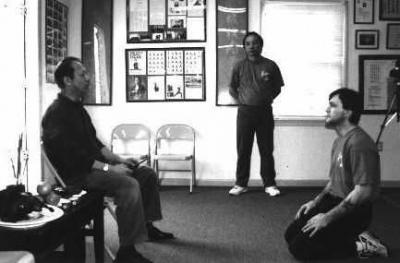
Foto tradicional SiFu-Todai, SiFu Marcos de Abreu ( sentado) e seu discípulo particular Aldary
 ( Dido)


WORKSHOP Técnicas de Defesa Pessoal com Kung Fu e Taekwondo

A Escola Eden (Casa Forte), promove workshop gratuito sobre o tema nesta sexta-feira (23), das 19h às 20h, com seus professores de artes marciais, para iniciar o tema entre as mulheres participantes.


WORKSHOP Techniques of Self Defense with Kung Fu and Taekwondo to Women

The Eden School (Fort House), promotes free workshop on Friday (23), from 19h to 20h, with his martial arts teachers to start the topic among women participants


Dido.

Discípulo particular do SiFu Marcos de Abreu em PE.


Dido

Private disciple of SiFu Marcos de Abreu in Recife - PE - Brazil